
Trabeculectomy in Ahmedabad - Glaucoma Filtration Surgery at Puja Eye Hospital
Trabeculectomy is the most established and widely performed surgical procedure for glaucoma worldwide. It creates a new drainage pathway for fluid to leave the eye, significantly lowering intraocular pressure and protecting the optic nerve from further damage.
At Puja Eye Hospital, trabeculectomy is performed by Dr. Puja Sheth in a fully equipped modular ophthalmic operation theatre using a Zeiss surgical microscope – the gold standard for precision eye surgery globally.
What Is Trabeculectomy?
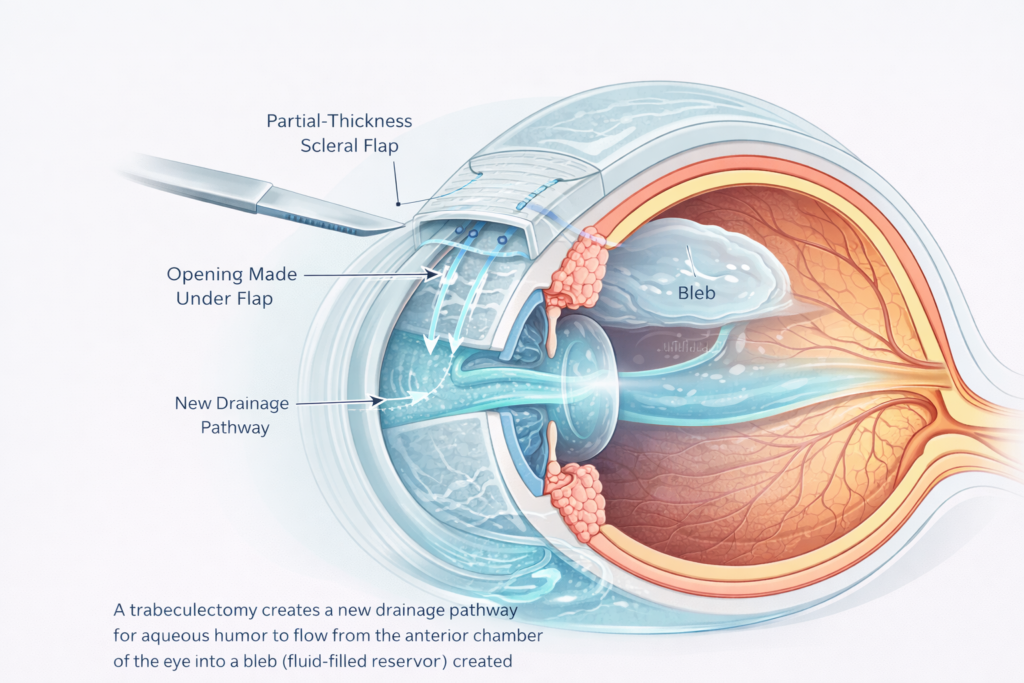
Trabeculectomy is a filtration surgery that creates a controlled, surgically made opening in the wall of the eye through which the aqueous fluid can drain out of the eye and be absorbed by the surrounding tissues. This new drainage route bypasses the eye’s blocked or dysfunctional natural drainage system, effectively lowering the eye pressure to a safer level.
The surgery creates a small blister-like reservoir under the conjunctiva (the transparent membrane covering the white of the eye) called a bleb. The bleb is the visible evidence that fluid is draining successfully through the new pathway.
When Is Trabeculectomy Recommended?
- Eye pressure remains uncontrolled despite maximum tolerated medical therapy (eye drops and tablets)
- Glaucoma is progressing - the optic nerve or visual field is continuing to deteriorate despite treatment
- The patient is unable to tolerate or consistently use the required number of eye drops
- The target eye pressure required to protect the optic nerve is very low - lower than can be achieved with drops alone
- Advanced glaucoma is present, where a significant and sustained reduction in eye pressure is essential
- The patient requires a surgical option that can provide long-term pressure control without daily drops
What to Expect - Before, During, and After Surgery
Before Surgery
A pre-operative assessment is conducted to evaluate the health of the eye and to plan the surgical approach. Certain eye drops may need to be adjusted before surgery. You will receive detailed instructions on fasting, medications to pause, and what to expect on the day.
During Surgery
Trabeculectomy is performed under local anaesthesia with sedation. You will be comfortable and relaxed throughout. The surgery takes approximately 45 to 60 minutes. The operating surgeon works under the Zeiss surgical microscope, which provides outstanding illumination and magnification for precise tissue work.
An antifibrotic agent (Mitomycin C or 5-Fluorouracil) may be applied during the surgery to reduce scarring around the bleb and improve the long-term success rate of the procedure.
After Surgery
You will be monitored for a few hours after surgery before discharge. A protective eye shield is worn overnight. Anti-inflammatory and antibiotic eye drops are prescribed and must be used diligently in the post-operative period.
Follow-up visits in the weeks after surgery are important, as the eye pressure and bleb function need to be carefully monitored and adjusted. Certain procedures – such as suture adjustment or bleb massage – may be performed in the clinic to optimise the drainage. Most patients notice a significant reduction in eye pressure within the first few weeks after surgery.
How Effective Is Trabeculectomy?
Trabeculectomy is highly effective at lowering intraocular pressure. The majority of patients achieve a significant and sustained reduction in eye pressure after the procedure, and many are able to reduce or eliminate their dependence on pressure-lowering eye drops.
Long-term success depends on bleb function. In some patients, the bleb may scar over time, reducing its effectiveness. Antifibrotic agents used during surgery improve long-term outcomes. If the bleb fails, further surgical intervention may be required.
Dr. Puja Sheth -Glaucoma Specialist

Puja Eye Hospital - Glaucoma And Superspeciality Eye Hospital
- +91 8780012121
- 401-402, The 132 Offices and Showrooms Near Shell Petrol Pump, Besides Indraprastha Saptak 132 Ft. Ring Road, AEC Cross Rd, Naranpura, Ahmedabad, Gujarat 380013
-
Monday to Saturday 9:30 am – 4:30 pm
Prior appointment necessary

Chief Glaucoma Consultant and Surgeon, Dr. Nagpal's Retina Foundation, Ahmedabad
- 079-22865537
- Retina Foundation, Near Shahibaug Underbridge, Old Raj Bahwan Road, Shahibaug, Ahmedabad - 380004, Gujarat, India.
-
Opening Hours Mon to Friday 09:am to 05:pm
Sat – 09:am to 11:am
FAQs
Trabeculectomy is a microsurgical procedure performed under local anaesthesia. While it is more involved than a laser procedure, it does not require general anaesthesia in most cases, and most patients go home the same day or the day after surgery. It is not open surgery in the conventional sense.
Many patients are able to reduce or stop their eye drops after a successful trabeculectomy. However, some patients still require one or more drops to achieve their target pressure, particularly those with advanced glaucoma. Dr. Sheth will review your medication requirements at each follow-up visit.
Like all surgical procedures, trabeculectomy carries risks. These include infection, bleeding, excessive scarring of the bleb leading to failure, very low eye pressure (hypotony) in the early post-operative period, and a small risk of cataract development or acceleration. Serious vision-threatening complications are uncommon in experienced hands. Dr. Sheth will discuss the specific risks applicable to your case before the procedure.
Yes. In some cases, combined surgery – trabeculectomy and cataract removal (phacoemulsification) in the same operation – may be recommended. This avoids two separate procedures and can be advantageous in selected patients. Dr. Sheth will advise whether combined surgery is appropriate in your case.
The initial recovery period – involving restricted activity, eye drop use, and frequent follow-up visits – lasts approximately 4 to 6 weeks. Vision may be temporarily blurred or variable during this time as the eye settles. Full stabilisation of the eye pressure and visual outcome may take 3 to 6 months.
Trabeculectomy is the most established and widely performed incisional glaucoma surgery worldwide. It creates a new drainage pathway from inside the eye to a small reservoir called a filtering bleb formed beneath the conjunctiva (the clear membrane over the white of the eye). Aqueous humour flows through this new pathway, bypassing the blocked trabecular meshwork, and is absorbed from the bleb into surrounding tissue – effectively lowering intraocular pressure (IOP). Trabeculectomy can achieve sustained IOP levels in the low to mid-teens, making it the surgery of choice for moderate-to-advanced glaucoma where aggressive IOP reduction is required to preserve remaining optic nerve function.
Trabeculectomy is recommended when: maximum tolerated medical therapy and/or laser treatment have failed to adequately control IOP; glaucoma is at a stage where the target IOP required to prevent further progression is below what medications or MIGS can reliably achieve; visual field loss is progressing despite current treatment; or the patient is unable to maintain a drop regimen due to intolerance, side effects, or adherence difficulties. In advanced glaucoma where the target IOP is in the range of 10–14 mmHg, trabeculectomy remains the most reliable surgical option. Dr. Puja Sheth discusses the risks, expected benefits, and alternatives comprehensively before recommending surgery.
Trabeculectomy at Puja Eye Hospital is performed in the dedicated modular operation theatre under local anaesthesia with IV sedation (peribulbar block). The procedure takes approximately 45–75 minutes. A small flap is created in the sclera (white of the eye), beneath which a portion of the trabecular meshwork and adjacent tissue is removed to create the drainage outlet. Antimetabolites – either Mitomycin-C (MMC) or 5-Fluorouracil (5-FU) — are applied intraoperatively to inhibit fibrosis and maintain long-term bleb function. The scleral flap is sutured loosely, allowing controlled aqueous egress, and the conjunctiva is closed with fine sutures. Releasable or laser-adjustable sutures are placed to allow post-operative IOP fine-tuning without additional surgery.
Mitomycin-C (MMC) is an antifibrotic agent applied to the surgical site during trabeculectomy to prevent excessive scarring, which is the primary cause of bleb failure and surgical failure over time. Without antimetabolite adjuncts, trabeculectomy success rates at 5 years are considerably lower, particularly in younger patients, those with prior surgeries, or those using multiple eye drops. MMC is applied on a small sponge for a precisely controlled time, then thoroughly washed out – it is not left permanently in the eye. With correct application technique and dosing by an experienced surgeon like Dr. Puja Sheth, MMC significantly improves long-term surgical success while adding only a modest increase in the risk of thin blebs or hypotony (excessively low IOP).
Trabeculectomy is major ophthalmic surgery and carries meaningful risks. Early complications include hypotony (IOP too low), choroidal effusions, hyphema (blood in anterior chamber), and wound leak. Late complications include bleb failure (scarring causing IOP to rise again), blebitis (bleb infection – about 1-2% lifetime risk), endophthalmitis (serious intraocular infection), cataract formation (accelerated by surgery), bleb dysaesthesia (discomfort from a prominent bleb), and chronic hypotony in some cases. Dr. Puja Sheth manages these risks through careful patient selection, meticulous surgical technique, post-operative bleb management including 5-FU injections if needed, and a structured follow-up protocol. Patients are counselled about the lifelong need for bleb surveillance.
Trabeculectomy requires a more extended recovery than MIGS or laser procedures. In the first 2 weeks, the eye is typically padded, vision is blurred, and multiple topical medications are used. IOP and bleb morphology are monitored closely, often with clinic visits every 3-5 days in the first 2 weeks. Physical activity is restricted for 4-6 weeks: no swimming, heavy lifting, or straining. By 6–8 weeks, most patients have stable IOP and improved vision. Suture lysis (using laser to release adjustable sutures) may be performed in the first 4 weeks to optimise IOP. Full bleb maturation and stable IOP typically occur by 3 months. Lifelong monitoring remains essential.
Yes bleb failure due to fibrosis can occur in a percentage of cases, typically in the months to years after surgery. Risk factors for failure include younger patient age, African or Asian ethnicity, prior conjunctival surgeries, prolonged use of multiple eye drops, and uveitic or neovascular glaucoma. If the IOP rises again post-trabeculectomy, management options include: subconjunctival 5-FU injections to suppress scar formation, bleb needling (a minor procedure to break down scar tissue), revision surgery, or implantation of a glaucoma drainage device. At Puja Eye Hospital, Ahmedabad, Dr. Puja Sheth performs post-trabeculectomy bleb management as a structured component of the long-term care programme.
Trabeculectomy is performed specifically to preserve remaining vision by controlling IOP – it does not restore vision already lost to glaucoma. Immediately postoperatively, vision is often temporarily reduced due to the surgery itself. Most patients return to functional vision within 4–8 weeks. Trabeculectomy modestly accelerates cataract development, and cataract surgery may be needed 2–5 years after trabeculectomy in some patients. When performed at the right time in the right patient by an experienced surgeon, the long-term benefit – halting glaucoma progression and preserving remaining sight – substantially outweighs the surgical risks and temporary vision disruption.