
Laser Iridotomy & Iridoplasty in Ahmedabad - Angle-Closure Glaucoma Treatment
Laser Iridotomy and Laser Iridoplasty are safe, minimally invasive procedures used to treat narrow-angle glaucoma and angle-closure glaucoma by improving the eye’s natural drainage and reducing eye pressure. These advanced Laser Glaucoma Treatment options help prevent optic nerve damage and protect your vision.
At Puja Eye Hospital, Naranpura, Ahmedabad, Dr. Puja Sheth, a trusted Glaucoma Specialist in Ahmedabad and Best Glaucoma Surgeon in Ahmedabad, performs these procedures after a Comprehensive Glaucoma Evaluation. Using advanced technology and personalized care, we provide effective Glaucoma Treatment in Ahmedabad to help patients preserve their eyesight and maintain long-term eye health.
Understanding Narrow -Angle and Angle-Closure Glaucoma
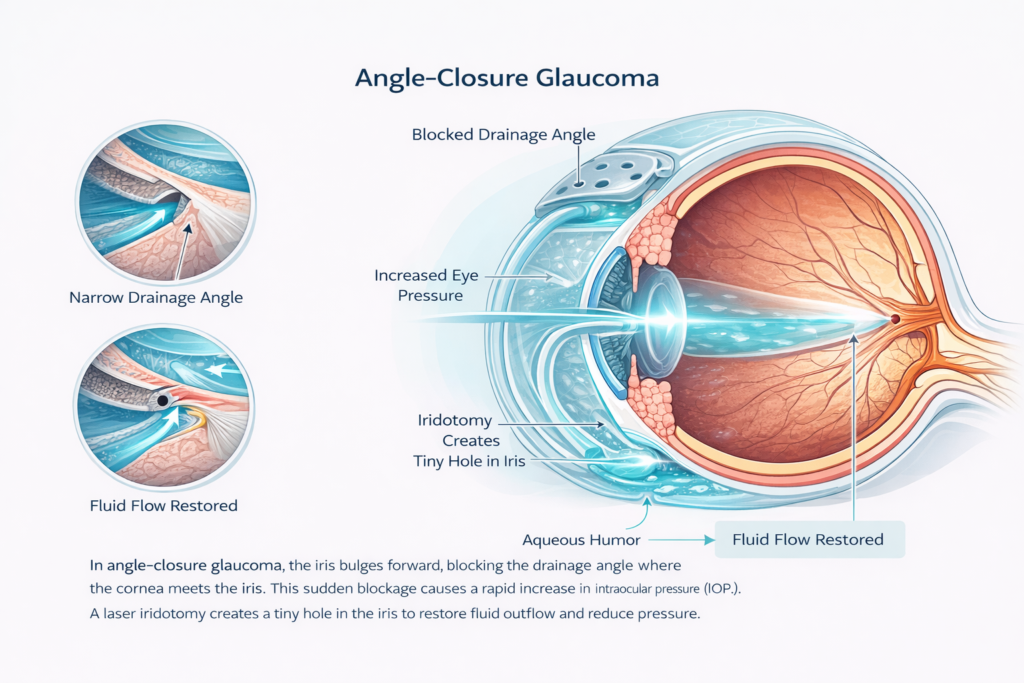
The eye continuously produces a fluid called aqueous humour, which drains out through a narrow channel called the drainage angle the space between the iris and the cornea. In some people, this angle is anatomically narrow or becomes blocked by the iris, preventing the fluid from draining normally. This causes eye pressure to rise, which can damage the optic nerve.
Angle-closure glaucoma can develop slowly over years (chronic angle-closure) or occur suddenly as an acute attack a medical emergency characterised by a sudden, severe rise in eye pressure accompanied by intense eye pain, headache, nausea, and blurred vision.
Laser procedures treat the underlying anatomical problem, preventing dangerous pressure rises before they occur.
Laser Peripheral Iridotomy (LPI)
Laser peripheral iridotomy is the primary treatment for eyes with narrow or closed drainage angles. During the procedure, a laser creates a tiny opening in the peripheral iris (the coloured part of the eye). This opening acts as a bypass channel, allowing aqueous fluid to flow more freely and equalising the pressure between the front and back chambers of the eye.
By relieving the pressure difference that pushes the iris forward and closes the angle, LPI prevents future episodes of angle closure and dramatically reduces the risk of an acute glaucoma attack.
Who Needs Laser Iridotomy?
- Patients with anatomically narrow drainage angles at risk of closure, even without symptoms
- Patients who have had an acute angle-closure glaucoma attack as an emergency or post-emergency procedure
- Patients with chronic angle-closure glaucoma
- Fellow eyes of patients who have had an acute attack in one eye (the other eye is at high risk)
- Patients with pigmentary glaucoma or plateau iris configuration, in selected cases
What to Expect During the Procedure
Laser iridotomy is performed as an outpatient procedure. Anaesthetic and pressure-lowering eye drops are applied before the procedure. You will sit at a slit lamp, and a special contact lens is placed on the eye to focus the laser precisely. The laser creates a small, nearly invisible opening in the iris in a matter of seconds.
The procedure takes approximately 5 to 10 minutes per eye. There is minimal discomfort most patients experience only a brief sensation of pressure or a mild flash of light during the laser application.
After the procedure, anti-inflammatory eye drops are prescribed for a few days. Your eye pressure is checked after the procedure and you are monitored briefly before discharge. Most patients resume normal activities the same day or the following day.
Laser Iridoplasty
Laser iridoplasty (also called peripheral iridoplasty or ALPI Argon Laser Peripheral Iridoplasty) is a complementary procedure used in specific situations where iridotomy alone is insufficient to open a very narrow or anatomically complex angle.
During iridoplasty, a ring of laser spots is applied to the peripheral iris, causing the iris tissue to contract and physically pull the iris away from the drainage angle, widening the angle and improving fluid drainage.
When Is Iridoplasty Used?
- When the drainage angle remains narrow or partially closed after an iridotomy
- In plateau iris syndrome a condition where the iris is positioned in a way that continues to crowd the drainage angle even after iridotomy
- As an emergency procedure to rapidly lower eye pressure in certain acute angle-closure situations
Are These Procedures Safe?
Both laser iridotomy and iridoplasty are very safe and well-established procedures with an excellent long-term safety record. Serious complications are uncommon. Mild, temporary side effects such as a brief rise in eye pressure immediately after the procedure or minor inflammation are managed with eye drops and resolve quickly.
Dr. Puja Sheth assesses the anatomy of each patient’s eye carefully before recommending a laser procedure and tailors the approach to the individual case.
Dr. Puja Sheth -Glaucoma Specialist
Puja Eye Hospital - Glaucoma And Superspeciality Eye Hospital
- +91 8780012121
- 401-402, The 132 Offices and Showrooms Near Shell Petrol Pump, Besides Indraprastha Saptak 132 Ft. Ring Road, AEC Cross Rd, Naranpura, Ahmedabad, Gujarat 380013
-
Monday to Saturday 9:30 am – 4:30 pm
Prior appointment necessary
Chief Glaucoma Consultant and Surgeon, Dr. Nagpal's Retina Foundation, Ahmedabad
- 079-22865537
- Retina Foundation, Near Shahibaug Underbridge, Old Raj Bahwan Road, Shahibaug, Ahmedabad - 380004, Gujarat, India.
-
Opening Hours Mon to Friday 09:am to 05:pm
Sat – 09:am to 11:am
FAQs
No. Anaesthetic drops are applied before the procedure. Most patients feel only a mild sensation or see a brief flash of light. The procedure is generally very well tolerated.
No. Laser iridotomy and iridoplasty are outpatient procedures. You will be observed for a short period after the procedure to check your eye pressure, and then discharged the same day.
Laser iridotomy prevents future angle-closure attacks and is very effective at protecting the eye from dangerous pressure spikes. However, if glaucoma damage has already occurred, the nerve damage cannot be reversed. Some patients with angle-closure glaucoma also require ongoing pressure-lowering eye drops alongside laser treatment.
The opening created by laser iridotomy is very small – typically less than 0.5 mm – and is located in the far periphery of the iris, usually hidden under the upper eyelid. Most patients cannot see it at all, and it does not affect vision.
Laser iridotomy is considered a permanent procedure. The opening created in the iris typically remains patent (open) for life. In a small proportion of patients, the opening can close over time and may need to be retreated.
Laser Peripheral Iridotomy (LPI) is a brief outpatient laser procedure in which a small opening is created in the peripheral iris (the coloured part of the eye) using a YAG laser. This opening creates an alternative pathway for aqueous humour to flow from the posterior chamber (behind the iris) to the anterior chamber (in front of the iris), relieving pupillary block — the mechanism underlying most cases of angle-closure glaucoma. LPI is recommended for: acute and chronic angle-closure glaucoma, narrow angles detected on gonioscopy before closure has occurred (prophylactic LPI), primary angle-closure suspects, and the fellow eye of a patient who has already had an acute attack. It is the standard first-line intervention for angle-closure disease and is available at Puja Eye Hospital, Naranpura, Ahmedabad.
Laser Peripheral Iridotomy (LPI) creates a small hole in the iris to relieve pupillary block – the main mechanism of angle closure. Laser Peripheral Iridoplasty (LPIP), also called argon laser peripheral iridoplasty (ALPI), uses a different laser (typically argon or diode) to place a ring of contraction burns on the peripheral iris, physically pulling it away from the drainage angle. Iridoplasty is used when angle closure persists after iridotomy due to mechanisms other than pupillary block — such as plateau iris syndrome, where the ciliary processes push the peripheral iris forward even after an adequate iridotomy. The two procedures may be used in combination. Dr. Puja Sheth selects the appropriate procedure based on gonioscopy findings, UBM (Ultrasound Biomicroscopy) results, and clinical examination.
Laser iridotomy is a non-incisional, outpatient procedure performed in the clinic – no operating theatre is required. The procedure at Puja Eye Hospital takes approximately 5–10 minutes per eye. After instilling topical anaesthetic and pupil-constricting drops, a contact lens is placed on the eye to focus the laser precisely on the peripheral iris. A YAG laser delivers a series of short, focused pulses that create a small, permanent opening (approximately 0.5 mm). The patient experiences a series of brief clicking sensations. There are no incisions, no injections, and no stitches. The patient returns home the same day after a brief post-procedure IOP check.
Most patients describe the experience of laser iridotomy as mild pressure or a brief stinging sensation with each laser pulse – not significant pain. Topical anaesthetic drops are used beforehand. Immediately after the procedure, patients may have mild blurring of vision, light sensitivity, and a dull ache around the eye, all of which typically resolve within a few hours. Anti-inflammatory eye drops are prescribed for 3–5 days post-procedure. Patients should arrange for someone to drive them home, as the pupil-constricting drops affect near vision. Dr. Puja Sheth reviews IOP at one hour post-laser to rule out a pressure spike, which can occasionally occur.
In pupillary-block angle closure, laser iridotomy is highly effective at relieving the underlying mechanism. Studies consistently show that LPI deepens the anterior chamber angle, reduces acute attack risk, and lowers IOP in a significant proportion of treated eyes. In the Zhongshan Angle-Closure Prevention (ZAP) trial, LPI demonstrated a reduction in acute angle-closure events in treated eyes compared to untreated fellow eyes. However, LPI does not always fully control IOP – especially in chronic angle closure where peripheral anterior synechiae (PAS) have already formed – and some patients will require additional medications, iridoplasty, or surgery. Effectiveness is highest when performed preventively, before synechiae form. |
Laser iridotomy at Puja Eye Hospital carries a very low risk profile when performed by an experienced glaucoma specialist like Dr. Puja Sheth. Possible side effects include a transient IOP spike immediately after the procedure (managed with IOP-lowering drops given pre-laser), mild anterior chamber inflammation (controlled with drops), and, rarely, dysphotopsia — some patients notice a visual line or arc in their peripheral vision if the iridotomy opening is not fully covered by the upper eyelid. Serious complications such as lens damage or cataract are rare with modern YAG laser technique. Bleeding from iris vessels at the time of laser is common but self-limiting.
This depends on whether you had established glaucoma damage and elevated IOP before the iridotomy. If the procedure was performed preventively in a narrow-angle eye with no existing damage and normal IOP, drops may not be required long-term. If glaucoma damage or raised IOP was already present, additional treatment – medications or further laser/surgery – is typically needed alongside the iridotomy. At Puja Eye Hospital, Dr Puja Sheth reassesses IOP, gonioscopy, and OCT status 4-6 weeks after LPI to determine whether the drainage angle has opened adequately and whether additional intervention is necessary.
Yes. Laser Peripheral Iridotomy and Laser Peripheral Iridoplasty are available at Puja Eye Hospital, Naranpura, Ahmedabad, under the care of Dr. Puja Sheth, a dedicated glaucoma specialist. The clinic is equipped with a Zeiss YAG laser system. Puja Eye Hospital serves patients from across Ahmedabad and referring cities in Gujarat. Appointments can be scheduled directly at the clinic; urgent referrals for suspected acute angle-closure are accommodated as soon as possible given the time-sensitive nature of the condition.