
Comprehensive Glaucoma Evaluation in Ahmedabad: Puja Eye Hospital
Glaucoma is often called the ‘silent thief of sight’ because it causes irreversible vision loss with little or no warning in its early stages. By the time most patients notice changes in their vision, significant and permanent damage has already occurred.
A Comprehensive Glaucoma Evaluation includes advanced diagnostic tests that help detect glaucoma at its earliest stage, monitor optic nerve health, and guide personalized Glaucoma Treatment in Ahmedabad. At Puja Eye Hospital, Dr. Puja Sheth uses internationally recognized diagnostic technology to provide accurate glaucoma diagnosis and long-term vision care.
What Is a Comprehensive Glaucoma Evaluation?
A Comprehensive Glaucoma Evaluation is a detailed eye examination designed to detect glaucoma early, assess optic nerve health, and protect your vision from permanent damage. Unlike a routine eye check-up, this evaluation combines several advanced diagnostic tests, including eye pressure testing (tonometry), optic nerve examination, OCT imaging, visual field testing (perimetry), gonioscopy, and corneal thickness measurement (pachymetry). These tests help identify glaucoma before noticeable symptoms develop and allow for accurate diagnosis and personalized treatment planning.
At Puja Eye Hospital, every evaluation is performed by Dr. Puja Sheth, a trusted Glaucoma Specialist in Ahmedabad, using advanced diagnostic technology to provide precise results. A comprehensive assessment not only detects glaucoma at an early stage but also monitors disease progression and guides the most effective Glaucoma Treatment in Ahmedabad.
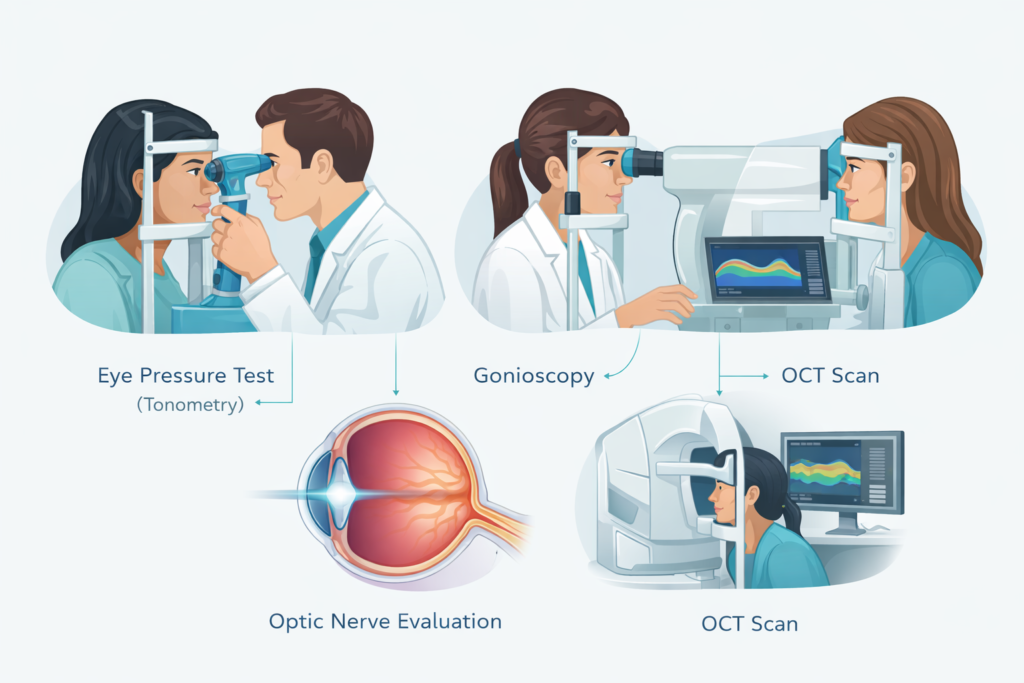
Components of the Evaluation
1. Eye Pressure Testing - Tonometry
Intraocular pressure (IOP) measurement is the most fundamental test in glaucoma care and an essential part of a Comprehensive Glaucoma Evaluation. Elevated eye pressure is the primary risk factor for glaucoma and the main target of all Glaucoma Treatment in Ahmedabad.
Tonometry measures the pressure inside the eye using a precise, calibrated instrument. At Puja Eye Hospital, eye pressure is measured using Goldmann Applanation Tonometry, the internationally accepted gold standard that provides highly accurate readings for glaucoma diagnosis.
It is important to note that some patients develop glaucoma despite having normal eye pressure (Normal-Tension Glaucoma), while others have elevated eye pressure without optic nerve damage. This is why eye pressure testing alone is never sufficient. It should always be interpreted together with other advanced diagnostic tests performed during a Comprehensive Glaucoma Evaluation by a Glaucoma Specialist in Ahmedabad.
2. Gonioscopy -Angle Examination
Gonioscopy is a specialized examination of the eye’s drainage angle, where the iris meets the cornea and where the aqueous humour drains from the eye. It is an important part of a Comprehensive Glaucoma Evaluation and cannot be performed during a routine eye examination.
This test determines whether the drainage angle is open, narrow, or closed, helping diagnose Open-Angle Glaucoma or Angle-Closure Glaucoma. The findings play a vital role in selecting the most effective Glaucoma Treatment in Ahmedabad.
Not every eye clinic performs gonioscopy routinely. At Puja Eye Hospital, it is a standard component of every Comprehensive Glaucoma Evaluation, ensuring accurate glaucoma diagnosis and personalized treatment planning.
3. OCT -Optical Coherence Tomography (Zeiss)
Optical Coherence Tomography (OCT) is an advanced imaging technology used during a Comprehensive Glaucoma Evaluation to create high-resolution cross-sectional images of the optic nerve and the Retinal Nerve Fibre Layer (RNFL).
Glaucoma gradually damages these delicate nerve fibres. OCT Scan for Glaucoma can detect early RNFL thinning long before noticeable vision loss occurs, allowing early diagnosis and timely Glaucoma Treatment.
At Puja Eye Hospital, we use the advanced Zeiss OCT System, one of the world’s most trusted imaging platforms. Serial OCT scans help monitor glaucoma progression and allow our Glaucoma Specialist in Ahmedabad to evaluate treatment effectiveness and preserve long-term vision.
4. RNFL Measurement - Optic Nerve Analysis
RNFL (Retinal Nerve Fibre Layer) measurement is generated during the OCT scan and is one of the most sensitive methods for detecting early glaucoma damage.
The scan compares your optic nerve measurements with international reference databases to identify even minor nerve fibre loss. Progressive RNFL thinning is one of the earliest signs of glaucoma and can often be detected before vision changes occur.
Regular RNFL analysis during a Comprehensive Glaucoma Evaluation enables Dr. Puja Sheth to monitor disease progression accurately and adjust Glaucoma Treatment in Ahmedabad whenever necessary to protect your vision.
5. Pachymetry - Corneal Thickness Measurement
Pachymetry measures the thickness of the cornea, the clear front surface of the eye. Although often overlooked, corneal thickness is an important risk factor evaluated during a Comprehensive Glaucoma Evaluation.
A thin cornea increases the risk of glaucoma progression and can cause eye pressure readings to appear lower than they actually are. Similarly, a thick cornea may result in falsely elevated pressure measurements.
By combining pachymetry with Eye Pressure Testing (Tonometry) and other advanced glaucoma tests, Dr. Puja Sheth can accurately assess your true eye pressure and develop the most effective Glaucoma Treatment Plan. This comprehensive approach helps ensure accurate diagnosis, personalized care, and long-term vision protection.
Who Should Have a Comprehensive Glaucoma Evaluation?
You should book a glaucoma evaluation if you have any of the following risk factors or concerns:
- A family history of glaucoma - first-degree relatives (parents, siblings) of glaucoma patients have a significantly higher ris
- Age above 40 years- glaucoma risk increases substantially with age
- Elevated eye pressure detected during a routine eye check
- Diabetes - diabetic patients have an increased risk of certain types of glaucoma
- Short-sightedness (myopia) -high myopia is associated with an increased risk of open-angle glaucoma
- Previous eye injury or trauma
- Long-term use of steroid eye drops, steroid inhalers, or oral steroids
- A history of eye surgery
- Any gradual changes in peripheral (side) vision
- A cup-to-disc ratio of 0.6 or higher noted on a previous eye examination
How Long Does the Evaluation Take?
Dr. Puja Sheth -Glaucoma Specialist
Puja Eye Hospital - Glaucoma And Superspeciality Eye Hospital
- +91 8780012121
- 401-402, The 132 Offices and Showrooms Near Shell Petrol Pump, Besides Indraprastha Saptak 132 Ft. Ring Road, AEC Cross Rd, Naranpura, Ahmedabad, Gujarat 380013
-
Monday to Saturday 9:30 am – 4:30 pm
Prior appointment necessary
Chief Glaucoma Consultant and Surgeon, Dr. Nagpal's Retina Foundation, Ahmedabad
- 079-22865537
- Retina Foundation, Near Shahibaug Underbridge, Old Raj Bahwan Road, Shahibaug, Ahmedabad - 380004, Gujarat, India.
-
Opening Hours Mon to Friday 09:am to 05:pm
Sat – 09:am to 11:am
FAQs
No. All components of the comprehensive glaucoma evaluation are non-invasive and painless. The gonioscopy lens involves brief contact with the eye surface after anaesthetic drops are applied, which is very well tolerated.
If dilating drops are used during the evaluation, your vision will be temporarily blurred and you will be sensitive to light for approximately 4 to 6 hours. It is advisable to arrange for someone to drive you home. If you prefer to avoid dilation, please inform the clinic at the time of booking so that the examination can be planned accordingly.
For patients newly diagnosed with glaucoma, follow-up evaluations are typically scheduled every 3 to 6 months initially. Once the condition is stable and well-controlled, annual evaluations may be sufficient. For high-risk individuals without confirmed glaucoma, annual screening is generally recommended.
A normal evaluation is very reassuring. However, glaucoma can sometimes develop or progress subtly. If you have significant risk factors, regular follow-up evaluations are recommended even after a normal result, as glaucoma is a lifelong condition that requires periodic monitoring.
No referral is required. You can book directly by calling or WhatsApp messaging Puja Eye Hospital. Many patients visit Dr. Sheth for a second opinion or as a self-referred patient with concerns about their eye pressure or a family history of glaucoma.
A comprehensive glaucoma evaluation is a structured, multi-parameter diagnostic assessment specifically designed to detect, stage, and monitor glaucoma – the leading cause of irreversible blindness worldwide. Unlike a routine eye check, which primarily assesses vision and basic eye health, a glaucoma evaluation includes intraocular pressure (IOP) measurement with a Goldman applanation tonometer, gonioscopy to examine the drainage angle, optic nerve head analysis, corneal pachymetry (central corneal thickness measurement), and a detailed visual field test (perimetry). At Puja Eye Hospital, Naranpura, Ahmedabad, Dr. Puja Sheth performs all components of this evaluation using Zeiss diagnostic equipment to ensure accuracy that directly guides treatment decisions. |
You should see a glaucoma specialist in Ahmedabad for a comprehensive evaluation if you are over 40 years of age, have a family history of glaucoma, have been told you have high eye pressure (ocular hypertension), are highly myopic (high minus power), have diabetes or hypertension, use steroid medications long-term, or have previously suffered an eye injury. Many patients have no symptoms in the early stages – glaucoma silently destroys peripheral vision long before central vision is affected. Early detection at a dedicated glaucoma clinic like Puja Eye Hospital is the only way to prevent permanent vision loss.
Dr. Puja Sheth’s comprehensive glaucoma evaluation protocol includes:
(1) Goldman applanation tonometry for precise IOP measurement;
(2) Pachymetry – corneal thickness measurement, which determines true risk from IOP readings;
(3) Gonioscopy – examination of the trabecular meshwork drainage angle to classify the glaucoma type as open-angle or closed-angle;
(4) Optic disc assessment using slit-lamp biomicroscopy and Zeiss OCT (Optical Coherence Tomography) for structural nerve fibre layer analysis;
(5) Humphrey visual field testing (perimetry) for functional assessment; and
(6) Fundus photography for baseline documentation. Each test provides a different layer of information, and together they give a complete picture of glaucoma presence and severity.
A first-visit comprehensive glaucoma evaluation typically takes 60 to 90 minutes. This includes the time required for pupil dilation (approximately 20–30 minutes), all diagnostic tests, and a detailed consultation with Dr. Puja Sheth to explain findings and recommend a treatment plan. Follow-up monitoring visits are shorter – usually 30 to 45 minutes – but still include updated IOP measurements, OCT, and visual field tests to track disease progression.
No. All tests in the evaluation are non-invasive or minimally invasive and performed under topical anaesthesia (numbing eye drops) where contact is required. Goldman tonometry involves a brief, gentle touch to the cornea. Gonioscopy uses a contact lens that rests on the eye for a few minutes with the help of numbing drops – most patients describe mild pressure but no pain. OCT and perimetry are entirely contactless. Pupil dilation causes temporary light sensitivity and blurred near vision for 3-4 hours, during which patients should not drive. |
Zeiss OCT (Optical Coherence Tomography) is central to modern glaucoma diagnosis. It generates micron-level cross-sectional images of the retinal nerve fibre layer (RNFL) and optic nerve head, allowing Dr. Puja Sheth to detect structural glaucomatous damage – often before any visual field defect appears on perimetry. At Puja Eye Hospital, Zeiss OCT enables early detection, accurate staging, and reliable monitoring of disease progression over time. Serial OCT scans form the objective backbone of every glaucoma follow-up plan.
Monitoring frequency is individualised based on disease severity, IOP control, and risk factors. As a general framework: patients with ocular hypertension or glaucoma suspect status typically require evaluation every 6–12 months; patients with mild to moderate glaucoma on treatment require review every 3–6 months; advanced glaucoma cases or those post-surgery may require review every 1-3 months. Dr. Puja Sheth tailors each follow-up schedule to the individual, ensuring that any progression is detected and treatment adjusted promptly.
Yes – and this is precisely why regular glaucoma evaluations matter. Glaucoma causes irreversible nerve damage, but when caught early, treatment can halt or significantly slow progression, preserving functional vision for life. At Puja Eye Hospital, Ahmedabad, patients who undergo structured monitoring with regular IOP checks, serial OCT, and visual field testing are managed proactively – adjusting medications or proceeding to laser or surgical treatment before advanced damage occurs. The key message: blindness from glaucoma is largely preventable with early detection and consistent specialist care.