
MIGS - Minimally Invasive Glaucoma Surgery in Ahmedabad
Minimally Invasive Glaucoma Surgery (MIGS) is an advanced Glaucoma Treatment in Ahmedabad that effectively lowers eye pressure with smaller incisions, faster recovery, and reduced surgical risk compared to traditional glaucoma surgery. It is an ideal option for patients with mild to moderate glaucoma who need long-term eye pressure control.
At Puja Eye Hospital, Naranpura, Ahmedabad, Dr. Puja Sheth, a trusted Glaucoma Specialist in Ahmedabad and Best Glaucoma Surgeon in Ahmedabad, performs MIGS Surgery using advanced technology, including the Zeiss surgical microscope, in a modern modular operation theatre. Following a Comprehensive Glaucoma Evaluation, each patient receives a personalized treatment plan to preserve vision and achieve the best possible surgical outcomes.
What Is MIGS?
MIGS is a category of surgical procedures that use microscopic, minimally traumatic approaches to lower intraocular pressure by enhancing the eye’s natural drainage pathways or creating new ones. Unlike traditional glaucoma surgery, MIGS procedures are designed to be quicker, safer, and more predictable – with a significantly lower risk of serious complications.
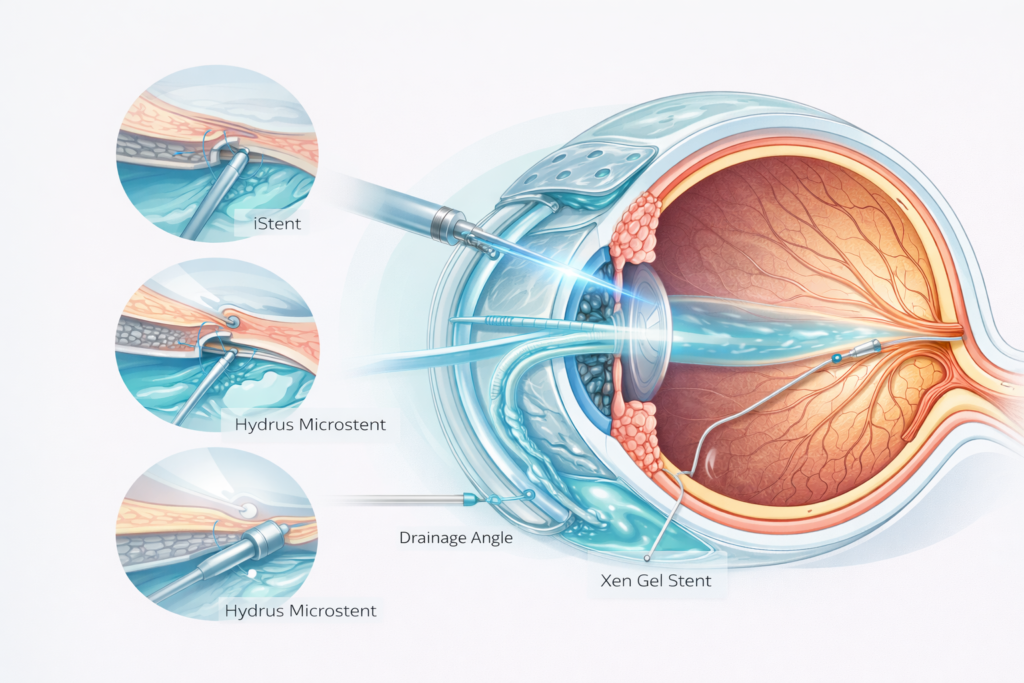
MIGS devices and techniques work through different mechanisms – some improve outflow through the eye’s natural trabecular meshwork, others create channels through the sclera (the white of the eye), and others reduce the production of aqueous fluid by treating the ciliary body.
How Does MIGS Differ from Trabeculectomy?
- A significantly lower risk of serious complications such as hypotony (dangerously low eye pressure) or infection
- Faster visual recovery - patients often experience better vision much sooner after MIGS than after trabeculectomy
- Less intensive post-operative monitoring and fewer follow-up visits required
- Easier combination with cataract surgery in a single operative session
Who Is a Candidate for MIGS?
MIGS is most appropriate for:
- Patients with mild to moderate open-angle glaucoma that is inadequately controlled on maximum tolerated medical therapy
- Patients undergoing cataract surgery who also have glaucoma - MIGS can be performed simultaneously, improving pressure control without a separate procedure
- Patients who are not tolerating or not able to consistently use their eye drops
- Patients who prefer a lower-risk surgical option and do not require the more aggressive pressure reduction that trabeculectomy provides
- Patients with early glaucoma in whom a step-up from drops is needed before committing to more invasive surgery
Not all patients are suitable candidates for every type of MIGS procedure. Dr. Sheth evaluates each patient’s angle anatomy, glaucoma severity, and clinical history to select the most appropriate approach.
MIGS Combined with Cataract Surgery
One of the most significant advantages of MIGS is that most procedures can be performed in combination with phacoemulsification (cataract surgery) through the same small incisions, at the same operative session.
For patients who have both a cataract and glaucoma, this combination approach achieves two goals in a single procedure – improved vision from cataract removal and improved pressure control from the MIGS device – reducing the need for separate surgeries and the cumulative risk that comes with multiple procedures.
What to Expect
Dr. Puja Sheth -Glaucoma Specialist

Puja Eye Hospital - Glaucoma And Superspeciality Eye Hospital
- +91 8780012121
- 401-402, The 132 Offices and Showrooms Near Shell Petrol Pump, Besides Indraprastha Saptak 132 Ft. Ring Road, AEC Cross Rd, Naranpura, Ahmedabad, Gujarat 380013
-
Monday to Saturday 9:30 am – 4:30 pm
Prior appointment necessary

Chief Glaucoma Consultant and Surgeon, Dr. Nagpal's Retina Foundation, Ahmedabad
- 079-22865537
- Retina Foundation, Near Shahibaug Underbridge, Old Raj Bahwan Road, Shahibaug, Ahmedabad - 380004, Gujarat, India.
-
Opening Hours Mon to Friday 09:am to 05:pm
Sat – 09:am to 11:am
FAQs
MIGS typically achieves a more modest reduction in eye pressure than trabeculectomy. For patients with mild to moderate glaucoma, this level of reduction is often sufficient to stabilise the disease. For patients with advanced glaucoma requiring very low target pressures, trabeculectomy or a tube shunt may be more appropriate. Dr. Sheth will recommend the most suitable procedure based on the severity of your glaucoma and your target eye pressure.
As with all surgical procedures, MIGS is not always successful. Some patients do not achieve adequate pressure reduction, or the initial benefit diminishes over time. If MIGS does not provide sufficient pressure control, further surgical intervention – such as trabeculectomy or a tube shunt – may be required.
Many patients are able to reduce their number of eye drops after MIGS. However, it is uncommon to be able to stop all drops entirely after MIGS alone. The goal is usually to improve pressure control and reduce the medication burden, not necessarily to eliminate drops completely.
Recovery after MIGS is generally faster than after trabeculectomy. Most patients experience improved or stable vision within days to weeks after the procedure. Post-operative restrictions – such as avoiding strenuous activity and swimming – typically apply for 2 to 4 weeks.
No. Several MIGS devices and techniques have been in clinical use for over a decade and have a well-established evidence base. They are performed routinely by specialist glaucoma surgeons worldwide and are supported by international glaucoma society guidelines.
Minimally Invasive Glaucoma Surgery (MIGS) is a category of glaucoma procedures characterised by a micro-incisional ab-interno approach (operating from inside the eye outward), minimal disruption to normal ocular anatomy, a high safety profile, and rapid recovery. Unlike traditional glaucoma surgeries such as trabeculectomy, MIGS procedures are performed through incisions typically less than 1.8 mm — the same size used in modern cataract surgery. MIGS devices and techniques target different parts of the aqueous humour outflow pathway: the trabecular meshwork (e.g., iStent, Kahook Dual Blade), the Schlemm’s canal (e.g., Hydrus microstent), the suprachoroidal space, or the subconjunctival space (e.g., Xen gel stent). Dr. Puja Sheth at Puja Eye Hospital, Ahmedabad, offers MIGS as part of a comprehensive glaucoma treatment programme.
MIGS is most appropriate for patients with mild to moderate open-angle glaucoma, particularly those who are intolerant of or non-compliant with glaucoma eye drops, those with early-to-moderate glaucoma requiring IOP reduction but not the aggressive lowering achievable with trabeculectomy, and patients undergoing cataract surgery simultaneously (combined phaco-MIGS is a very efficient option). MIGS is generally not the first choice for advanced glaucoma requiring very low target IOPs or for complex secondary glaucomas. Dr. Puja Sheth evaluates candidacy based on gonioscopy findings, baseline IOP, extent of optic nerve damage, and the patient’s overall ocular and systemic health.
Puja Eye Hospital offers a range of MIGS options including trabecular microbypass devices (iStent inject), excisional goniotomy using the Kahook Dual Blade (KDB), and canaloplasty-based approaches. The selection of the specific MIGS procedure is individualised by Dr. Puja Sheth based on gonioscopy findings, the angle anatomy, the target IOP required, and whether the patient is also undergoing cataract extraction. Combined phacoemulsification and MIGS (phaco-MIGS) is particularly effective – addressing both lens opacity and outflow obstruction in a single surgical setting
Phaco-MIGS refers to the combination of standard cataract surgery (phacoemulsification) with a MIGS procedure performed in the same operative sitting. This combination is advantageous for several reasons: cataract surgery itself deepens the anterior chamber angle and can lower IOP, and the MIGS device further enhances outflow, providing additive IOP reduction beyond what either procedure achieves alone. Performing both procedures together also means one anaesthetic exposure, one recovery period, and one set of post-operative drops – significantly more convenient for the patient. The modular operation theatre at Puja Eye Hospital is set up to accommodate combined procedures safely
MIGS procedures typically achieve a modest to moderate IOP reduction – generally a 20-40% reduction from baseline, with many patients reducing or eliminating glaucoma medications. By comparison, trabeculectomy achieves greater IOP lowering (often 40–50% reduction), reaching lower absolute IOP levels. The trade-off is that MIGS has a significantly superior safety profile and recovery compared to trabeculectomy. For patients with mild to moderate glaucoma who need IOP reduced from, say, 22-26 mmHg to 16-18 mmHg, MIGS is often the ideal choice. For patients requiring IOP in the low teens (e.g., advanced glaucoma with a target IOP of 10-12 mmHg), trabeculectomy or a drainage device is typically recommended by Dr. Puja Sheth.
Recovery from MIGS is considerably faster than from trabeculectomy or tube shunt surgery. Most patients experience minimal discomfort, and functional vision often recovers within days. Topical anti-inflammatory and antibiotic drops are prescribed for 4–6 weeks post-operatively. There are no sutures to remove and no large bleb to manage. Patients are reviewed at day 1, 1 week, 1 month, and 3 months post-surgery at Puja Eye Hospital, Naranpura, Ahmedabad. Physical activity restrictions are brief – usually one to two weeks of avoiding strenuous exertion, swimming, and eye rubbing. Most patients return to normal daily activities within 1-2 weeks.
MIGS procedures are among the safest interventions in glaucoma surgery, with complication rates significantly lower than trabeculectomy or tube shunts. Potential complications include transient hyphema (blood in the anterior chamber), which typically clears within 1–2 weeks, device malposition (rare), inadequate IOP reduction requiring additional treatment, and the general risks of any intraocular surgery (infection, inflammation). There is no risk of the serious bleb-related complications (blebitis, endophthalmitis) seen with trabeculectomy. The safety profile of MIGS makes it an appropriate choice for patients who need IOP reduction but for whom the risks of more invasive surgery are undesirable.
Yes. An important advantage of most MIGS procedures is that they do not compromise the conjunctiva – the thin tissue overlying the eye – which is critical for the success of future trabeculectomy if it is needed later. Patients who have undergone trabecular MIGS procedures remain candidates for trabeculectomy or tube shunt surgery if their glaucoma progresses. Dr. Puja Sheth’s approach is always to plan within the patient’s entire treatment trajectory: selecting a MIGS procedure today that provides benefit now while preserving future surgical options if required.