
Types of Glaucoma & Treatment in Ahmedabad - Puja Eye Hospital
Glaucoma is not a single eye disease but a group of conditions that damage the optic nerve, often due to increased intraocular pressure (eye pressure). If left untreated, glaucoma can cause progressive and irreversible vision loss, making it one of the leading causes of permanent blindness. Early diagnosis through a Comprehensive Glaucoma Evaluation is essential to protect your eyesight and prevent further optic nerve damage.
Each type of glaucoma has a unique cause, develops differently, and requires a personalized treatment approach. Identifying the exact type of glaucoma is the first step toward effective Glaucoma Treatment in Ahmedabad and long-term vision preservation.
At Puja Eye Hospital, Naranpura, Ahmedabad, Dr. Puja Sheth (MBBS, DNB Ophthalmology, FIGS), a trusted Glaucoma Specialist in Ahmedabad and Best Glaucoma Surgeon in Ahmedabad, provides comprehensive glaucoma diagnosis, advanced diagnostic testing, Laser Glaucoma Treatment, MIGS Surgery, Trabeculectomy, and Glaucoma Drainage Device (Tube Shunt) Surgery. With personalized care and modern technology, we are committed to helping patients preserve their vision and achieve the best possible outcomes through advanced glaucoma management.
1. Primary Open-Angle Glaucoma (POAG)
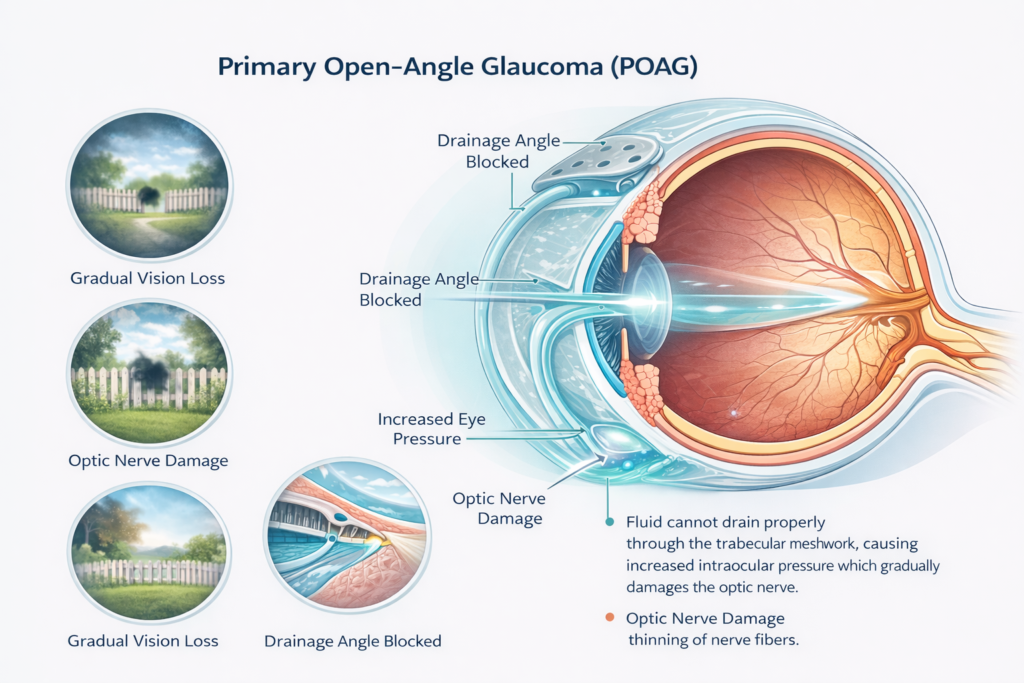
Primary open-angle glaucoma is the most common type of glaucoma worldwide, accounting for the majority of all glaucoma cases. It develops slowly and silently; there are no symptoms in the early stages, and most patients are unaware of any problem until significant damage has already occurred.
What Causes POAG?
Primary Open-Angle Glaucoma (POAG) is the most common type of glaucoma. The eye’s drainage angle remains open, but the drainage channels gradually become less effective, causing fluid build-up and increased eye pressure. Over time, this can damage the optic nerve and lead to permanent vision loss. Early detection through a Comprehensive Glaucoma Evaluation by a Glaucoma Specialist in Ahmedabad is important for timely Glaucoma Treatment in Ahmedabad and long-term vision protection.
Who Is at Risk?
- People above 40 years of age - risk increases significantly with age
- Individuals with a first-degree family history of glaucoma
- Patients with elevated eye pressure (ocular hypertension)
- Patients with high myopia (short-sightedness)
- Patients with thin corneas
Who Is at Risk?
2. Angle-Closure Glaucoma
Acute vs. Chronic Angle Closure
Angle-closure glaucoma occurs when the drainage angle of the eye is narrowed or blocked by the iris, preventing aqueous fluid from draining normally and causing the eye pressure to rise sometimes suddenly and dramatically.
Angle-closure glaucoma can present in two ways. Acute angle-closure glaucoma is a medical emergency – characterised by a sudden, severe rise in eye pressure accompanied by intense eye pain, redness, headache, nausea, halos around lights, and significantly blurred vision. This requires immediate treatment. Chronic angle-closure glaucoma develops more slowly, sometimes without dramatic symptoms, and is detected through gonioscopy during a comprehensive eye examination.
Risk Factors
- Far-sightedness (hyperopia) - farsighted eyes tend to have shallower anterior chambers and narrower angles
- Older age - the lens of the eye grows throughout life, gradually pushing the iris forward
- Asian ethnicity - angle-closure glaucoma is significantly more common in Asian populations
- Family history of angle-closure glaucoma
Treatment
Laser peripheral iridotomy is the primary treatment for eyes with narrow or closed angles. It creates a bypass channel in the iris that relieves the pressure differential and opens the drainage angle. Medical therapy and, in some cases, surgery are used alongside laser treatment when needed.
3. Normal-Tension Glaucoma (NTG)
Normal-tension glaucoma is a type of open-angle glaucoma in which the optic nerve is damaged despite the eye pressure being within the statistically normal range (below 21 mmHg). This is not a rare condition – it accounts for a significant proportion of glaucoma cases in South and East Asian populations.
Why Does NTG Occur?
The exact mechanism is not fully understood, but it is believed that in NTG, the optic nerve is unusually vulnerable to pressure-related damage – even at pressures that would not cause damage in most people. Vascular factors – including reduced blood flow to the optic nerve – may also play a role.
Treatment
Despite having a normal eye pressure, treatment of NTG still focuses on lowering intraocular pressure – often to very low target levels to slow or prevent further optic nerve damage. This is achieved with pressure-lowering eye drops, laser, or surgery, depending on the severity and rate of progression.
4. Secondary Glaucoma
Secondary glaucoma refers to elevated intraocular pressure and glaucomatous optic nerve damage that occurs as a consequence of another identifiable eye condition or systemic disease. It is important to identify and treat the underlying cause alongside managing the elevated pressure.
Common Causes of Secondary Glaucoma
- Steroid-induced glaucoma - prolonged use of steroid eye drops, steroid inhalers, nasal sprays, or oral steroids in susceptible individuals
- Pseudoexfoliation glaucoma - caused by the deposition of abnormal protein material in the drainage structures of the eye
- Pigmentary glaucoma - caused by pigment granules shedding from the iris and clogging the trabecular meshwork
- Neovascular glaucoma - caused by abnormal blood vessel growth in the drainage angle, most commonly associated with diabetic retinopathy or retinal vein occlusion
- Traumatic glaucoma - caused by injury to the eye that damages the drainage angle
- Uveitic glaucoma - caused by inflammation within the eye
Treatment
Treatment is tailored to both the underlying cause and the elevated pressure. Stopping or reducing the causative agent (such as steroid eye drops) is the first step where possible. Pressure-lowering drops, laser, or surgery are used based on the severity and response to initial measures.
5. Congenital and Childhood Glaucoma
Congenital glaucoma is present from birth or develops in infancy and early childhood. It is caused by abnormal development of the eye’s drainage system during foetal development, resulting in obstruction of aqueous outflow and elevated intraocular pressure from a very early age.
Signs and Symptoms in Children
- Enlarged eyes - the infant eye is more elastic than the adult eye and expands under the elevated pressure (buphthalmos)
- Excessive tearing
- Sensitivity to light (photophobia)
- Cloudy or hazy corneas
- Frequent blinking or eye rubbing
Treatment
Congenital glaucoma is primarily treated with surgery. Angle surgery (goniotomy or trabeculotomy) is performed to open the abnormal drainage tissue and restore normal aqueous outflow. Medical therapy and further surgical procedures may be required alongside or after the primary intervention.
Why Early Diagnosis Matters in All Types of Glaucoma
Regardless of the type of glaucoma, the single most important factor in preserving vision is early detection. The optic nerve damage caused by glaucoma is irreversible – vision that is lost cannot be restored. Treatment can slow or halt progression, but it cannot reverse damage that has already occurred.
For patients with risk factors, such as family history, elevated eye pressure, age above 40, diabetes, or previous eye problems, a comprehensive glaucoma evaluation with an experienced glaucoma specialist is the most effective investment in long-term eye health.
Dr. Puja Sheth -Glaucoma Specialist

Puja Eye Hospital - Glaucoma And Superspeciality Eye Hospital
- +91 8780012121
- 401-402, The 132 Offices and Showrooms Near Shell Petrol Pump, Besides Indraprastha Saptak 132 Ft. Ring Road, AEC Cross Rd, Naranpura, Ahmedabad, Gujarat 380013
-
Monday to Saturday 9:30 am – 4:30 pm
Prior appointment necessary
Chief Glaucoma Consultant and Surgeon, Dr. Nagpal's Retina Foundation, Ahmedabad
- 079-22865537
- Retina Foundation, Near Shahibaug Underbridge, Old Raj Bahwan Road, Shahibaug, Ahmedabad - 380004, Gujarat, India.
-
Opening Hours Mon to Friday 09:am to 05:pm
Sat – 09:am to 11:am
FAQs
Glaucoma cannot be cured in the conventional sense the optic nerve damage that has already occurred is irreversible. However, with the right treatment, glaucoma can be controlled very effectively, and further vision loss can be prevented or slowed significantly. Many patients with well-managed glaucoma maintain good functional vision for life.
Yes. Glaucoma commonly affects both eyes, although it may develop at different rates in each eye. Both eyes are always examined and monitored, even if only one eye appears to have significant disease at the time of diagnosis.
Yes. A family history of glaucoma, particularly in first-degree relatives (parents or siblings), is one of the strongest known risk factors. First-degree relatives of glaucoma patients should have a comprehensive glaucoma evaluation regularly, even if they have no symptoms.
The type of glaucoma is determined through a comprehensive evaluation that includes tonometry, gonioscopy, OCT imaging, visual field testing, and optic nerve assessment. Gonioscopy , the angle examination is particularly important for distinguishing between open-angle and angle-closure types.
Most types of glaucoma cannot be entirely prevented. However, early detection through regular screening particularly if you have risk factors means that treatment can be started before significant vision loss occurs. Avoiding unnecessary or unsupervised long-term steroid use is one actionable step that reduces the risk of steroid-induced glaucoma.
Glaucoma is not a single disease but a group of conditions that damage the optic nerve, usually through elevated intraocular pressure. The main types are:
(1) Primary Open-Angle Glaucoma (POAG) the most common form, where the drainage angle remains open but the trabecular meshwork becomes less efficient, causing a gradual, painless rise in IOP;
(2) Primary Angle-Closure Glaucoma (PACG) – particularly prevalent in South Asian populations including Gujarat, where the drainage angle is anatomically narrow or closes, causing a rapid or chronic rise in IOP;
(3) Normal Tension Glaucoma (NTG) – optic nerve damage occurs despite IOP within the normal range, often linked to poor optic nerve blood supply;
(4) Secondary Glaucoma – arising from other eye conditions such as uveitis, pseudoexfoliation syndrome, diabetes, or previous trauma;
(5) Congenital Glaucoma – present from birth, requiring early surgical intervention. At Puja Eye Hospital, Ahmedabad, Dr. Puja Sheth diagnoses and manages all types.
Primary angle-closure glaucoma (PACG) is significantly more prevalent in Asian populations compared to European populations, and India – including Gujarat — has a disproportionately high burden. The anatomical reason is that South Asian eyes tend to have shallower anterior chambers and thicker, more anteriorly positioned crystalline lenses, which predispose the drainage angle to crowding and closure. This is further compounded by high hyperopia (plus power) being common in the region. Because acute angle-closure can present as a sudden, painful red eye with nausea, it is often misdiagnosed as migraine or gastritis – making access to a glaucoma specialist in Ahmedabad for prompt diagnosis critical. |
Acute angle-closure glaucoma (AACG) is an ophthalmic emergency in which the drainage angle suddenly and completely closes, causing IOP to spike rapidly — often above 50–60 mmHg. Symptoms include severe eye pain, headache, nausea and vomiting, coloured halos around lights, and sudden vision blurring. Without treatment within hours, permanent vision loss can occur. Chronic angle-closure glaucoma develops slowly over months to years with repeated sub-acute episodes or gradual closure, causing progressive optic nerve damage often without acute symptoms. Both forms require prompt evaluation and treatment by a glaucoma specialist; acute cases need emergency management, typically with intravenous medications followed by laser iridotomy or surgery.
Normal tension glaucoma (NTG) is a form of open-angle glaucoma where the optic nerve sustains progressive damage despite IOP consistently within the statistically normal range (≤21 mmHg). The pathophysiology involves compromised optic nerve blood supply (vascular dysregulation), mechanical susceptibility of the optic nerve head, and possibly autoimmune factors. Patients often have associated conditions like migraines, low blood pressure, or nocturnal hypotension. Treatment aims to reduce IOP below the already-normal baseline – typically targeting a 30% reduction using topical medications, laser trabeculoplasty, or surgery. Systemic factors such as blood pressure management and improving nocturnal perfusion are also addressed. Dr. Puja Sheth has specific expertise in NTG, a condition frequently under-recognised in general ophthalmology practice.
Glaucoma treatment follows a step-wise approach tailored to the type, severity, and risk profile. The main options available at Puja Eye Hospital are:
(1) Medical therapy topical eye drops (prostaglandin analogues, beta-blockers, alpha agonists, carbonic anhydrase inhibitors), remains first-line for most patients;
(2) Laser treatment : Laser Peripheral Iridotomy (LPI) for angle closure, Selective Laser Trabeculoplasty (SLT) for open-angle glaucoma;
(3) Minimally Invasive Glaucoma Surgery (MIGS) micro-incisional procedures like iStent or Kahook Dual Blade, often combined with cataract surgery;
(4) Trabeculectomy the gold-standard incisional surgery for moderate-to-advanced glaucoma;
(5) Glaucoma Drainage Devices (tube shunts) for refractory or complex glaucoma. Dr. Puja Sheth selects treatment based on a detailed evaluation, not a protocol, ensuring each patient receives the most appropriate intervention
Glaucoma cannot be cured in the sense of restoring already-damaged nerve fibres optic nerve damage from glaucoma is permanent. However, glaucoma can be effectively controlled throughout life. With appropriate treatment whether eye drops, laser, or surgery IOP is lowered to a target level that prevents or significantly slows further nerve damage. Many patients maintain stable vision for decades with proper management. The critical insight is: treatment preserves the vision you have, but cannot recover what has been lost. This is why early diagnosis at a dedicated glaucoma clinic in Ahmedabad is paramount.
Untreated glaucoma leads to progressive, irreversible optic nerve damage and permanent visual field loss. The pattern typically begins with loss of peripheral (side) vision, which patients often do not notice until significant damage has occurred. Advanced glaucoma causes tunnel vision and, ultimately, complete blindness if left uncontrolled. Acute angle-closure glaucoma can cause permanent vision loss within 24–48 hours without treatment. There is no treatment to restore vision once the optic nerve has been irreversibly damaged, making prevention through regular evaluation and early treatment the cornerstone of glaucoma care at Puja Eye Hospital, Naranpura, Ahmedabad.
Yes. First-degree relatives (parents, siblings, children) of a person diagnosed with glaucoma have a 4–9 times higher risk of developing the condition compared to the general population. Primary open-angle glaucoma has a strong genetic component, with several identified gene mutations (including MYOC, OPTN, TBK1). Family history is one of the most significant risk factors in Dr. Puja Sheth’s glaucoma screening protocol. If you have been diagnosed with glaucoma in Ahmedabad, it is strongly advisable for all first-degree relatives aged 35 and above to undergo a comprehensive glaucoma evaluation, even if they have no current visual symptoms.